Poll: Two thirds say gas prices will shape their November vote
National News

Audio By Carbonatix
3:20 PM on Wednesday, June 24
Brett Rowland
(The Center Square) – Nearly half of American voters blame wars and conflicts for elevated gas prices, and two thirds say fuel costs will influence their vote in November, a new national poll finds.

The Center Square Voters' Voice Poll - Logo - White Background
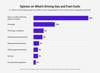
The Center Square Voters' Voice Poll found 49% of registered voters say wars or conflicts affecting global oil markets are most responsible for current gas and fuel prices. Another 8% blamed federal government policies and 9% blamed oil and gas companies.
Americans have paid an estimated $61.8 billion in extra fuel costs since the U.S. conflict with Iran began, or about $471 per household, according to Brown University's Iran War Energy Cost Tracker.
Poll: Two thirds say gas prices will shape their November vote
Data: The Center Square Voters’ Voice Poll (June 2026)
Mike Noble, founder of Noble Predictive Insights, which conducted the poll, said the 19% who said all factors are equally responsible likely reflects voters who see gas prices as a complex issue driven by multiple forces at once.
"The 'all equally responsible' response may actually reflect a more nuanced view – or in some cases skepticism of overly simple political explanations," Noble told The Center Square. "It suggests that while voters may lean toward blaming global conflict most, a meaningful share sees the issue as broader and more interconnected than that."
Two thirds of voters, 66%, say gas and fuel prices will likely influence their vote in November. Thirty-seven percent say it is very likely.

TCS VVP Jun 2026 - Gas and Fuel Prices as a Voting Issue
Data: The Center Square Voters’ Voice Poll (June 2026)
The likelihood of gas prices influencing the vote varied by party. Democrats were most likely to say prices would influence their vote at 81%, compared to 56% of true independents and 53% of Republicans.
Lower-income voters were most likely to say gas prices would influence their vote. Among those earning less than $50,000 annually, 69% said prices would likely influence their ballot choice, compared to 67% among those earning $50,000 to $100,000 and 62% among those earning more than $100,000.
Desmond Lachman, a senior fellow at the American Enterprise Institute and former International Monetary Fund official, said voters are right to connect the war to higher prices, but said the finding offers Trump little political cover.
"If most people think that the war caused high gas prices, they also think that this was a war of choice," Lachman told The Center Square. "So that's not good for President Trump, because they're thinking that the war caused those high prices, and he was the one who initiated the war."
Lachman said he was surprised the figure was not higher. Oil prices jumped sharply when Operation Epic Fury, the U.S. military conflict with Iran, began in February, he said, and gas prices followed – rising from about $3 a gallon to a peak of $4.50, according to AAA. Brent crude oil prices rose from about $71 a barrel before the war to a peak of about $124 a barrel in April, before falling to about $74 a barrel as of Wednesday, according to the U.S. Energy Information Administration. The national average gas price has since fallen to $3.92 per gallon as of Wednesday, down from $4.53 a month ago, according to AAA.
Gas prices are not the only economic pressure facing American households. Overall consumer prices rose 4.2% over the past year through May 2026, the largest 12-month increase since April 2023, according to Bureau of Labor Statistics data. Ground beef has risen 22%, from $5.55 to $6.75 per pound since January 2025, while ground coffee has jumped 35%, from $7.02 to $9.51 per pound, according to BLS average price data. Real wages have fallen back to where they stood when Trump took office in January 2025, according to Bureau of Labor Statistics data.
Jeff Colgan, a professor at Brown University's Watson Institute for International and Public Affairs who tracks the war's energy costs, said voters are reacting to a clear cause and effect.
"Voters are reacting understandably to the way fuel prices skyrocketed after President Trump's decision to attack Iran on February 28," Colgan told The Center Square. "Everyone could see the direct connection between higher prices at the pump and this war."
The Trump administration has characterized Operation Epic Fury as a necessary military action to prevent Iran from developing nuclear weapons.
The American Petroleum Institute, the oil and gas industry's main trade group, said energy prices are shaped by forces beyond domestic producers' control.
"Energy prices are shaped by global supply and demand dynamics, geopolitical events and market disruptions that affect energy systems around the world," an API spokesperson told The Center Square. "America's oil and natural gas producers are focused on meeting consumer demand, strengthening energy security and investing in the infrastructure needed to keep energy flowing safely and reliably."
The White House said Trump predicted the disruptions ahead of time and that prices will fall once the Iran conflict is resolved.
"President Trump was clear all along that there would be short-term, temporary disruptions to energy markets, and that oil and gas prices will quickly fall as soon as the Iran situation is resolved," spokeswoman Taylor Rogers told The Center Square. "President Trump has a proven track record of bringing gas prices to historic lows, and the Administration continues to take aggressive action to deliver economic relief for the American people."
Lachman said the political landscape may shift as prices continue to fall. With the Strait of Hormuz, a critical waterway through which roughly 20% of the world's oil passes, reopening and oil prices already falling, he predicted gas prices could return to pre-war levels — if diplomatic talks continue and the strait remains open.
"Going into November, gasoline prices are going to be coming back towards the $3 a gallon that they were before the war," he told The Center Square. "The question is whether voters can remember that between February and July, they had to pay very high gasoline prices, or are they going to remember that when they go to vote, the gasoline price is no longer a big issue."
Adie Tomer, a senior fellow at the Brookings Institution who studies transportation and household energy costs, said lower-income voters' heightened concern reflects economic reality.
"I would expect that lower earning households are going to be more sensitive in polling to saying yes, we have actually noticed these gas price increases, and they are negatively influencing our economic situation," Tomer told The Center Square.
Tomer said whether gas prices actually change votes depends on how fast prices fall and how long voter memory lasts – two things that won't be known until Election Day.
"My instinct would be that we are going to see this linger into the November elections," he told The Center Square. "These are going to be permanent headwinds for Republican candidates."
Tomer said the 28-point gap between Democrats and Republicans largely reflects partisan politics, but pointed to a complicating factor – residents of Republican-represented congressional districts drive 26% to 27% more miles per capita than those in Democratic districts.
"Republican-affiliated, Republican-registered voters are pointing the finger at their own registered party for some of the reasons that gas prices are higher," he told The Center Square.
Lachman said gas prices are a significant factor in Trump's deteriorating economic approval, but said other issues will persist even if prices recover.
"Since the war started, his numbers are crashing on the economy," he told The Center Square. "He's still going to have a negative rating on his handling of the economy going into the election, but maybe it won't be as bad as it is right now when people aren't still suffering from the high gasoline prices."
The offices of Reps. Brett Guthrie, R-Ky., Frank Pallone, D-N.J., and Gabe Vasquez, D-N.M., did not respond to requests for comment.
Colgan said the blame question may be only part of the story heading into November.
"The way voters weigh the blame or responsibility for the conflict, and whether it was worth the economic pain – to say nothing of the human costs – could be a big factor in the elections come November," he told The Center Square.
Noble Predictive Insights conducted the poll for The Center Square from June 1-4, 2026. It surveyed registered voters nationally via opt-in online panel and text-to-web cell phone messages. The sample included 2,585 respondents, including 915 Republicans, 1,013 Democrats, and 297 True Independents. The margin of error is plus or minus 1.93%.